Read ebook «The Cyberiad» online
Font size:
“Need a secret agent? My dad’s a secret agent. Dependable and cheap.”
“Very well then, take me to your dad,” said Klapaucius, seeing he would get nowhere with the child. The child led him to one of the houses. Inside, though it was in the middle of the day, a family sat around a lighted lamp—a gray grandfather in a rocking chair, a grandmother knitting socks, and their fully grown and numerous progeny, each busy at his own household task. As soon as Klapaucius entered, they jumped up and seized him; the knitting needles turned out to be handcuffs, the lamp a microphone, and the grandmother the local chief of police.
“They must have made a mistake,” thought Klapaucius, when he was beaten and thrown in jail. Patiently he waited through the night—there was nothing else he could do. The dawn came and revealed the cobwebs on the stone walls of his cell, also the rusted remains of previous prisoners. After a length of time he was taken and interrogated. It turned out that the little child as well as the houses—the whole village, in fact—all of it was a plant to trick foreign spies. But Klapaucius did not have to face the rigors of a long trial; the proceedings were quickly over. For attempting to establish contact with the informer-dad the punishment was a third-class guillotining, because the local administration had already allotted funds to buy out enemy agents for that fiscal year, and Klapaucius, on his part, repeatedly refused to purchase any State secrets from the police. Nor did he have sufficient ready cash to mitigate the offense. Still, the prisoner continued to protest his innocence—not that the judge believed a word of it; even if he had, to free him lay outside his jurisdiction. So the case was sent to a higher court, and in the meantime Klapaucius was subjected to torture, though more as a matter of form than out of any real necessity. In about a week his case took a turn for the better; finally acquitted, he proceeded to the Capitol where, after receiving instructions in the rules and regulations of court etiquette, he obtained the honor of a private audience with the King. They also gave him a bugle, for every citizen was obliged to announce his comings and goings in official places with appropriate flourishes, and such was the iron discipline of that land, that the sun was not considered risen without the blowing of reveille.
Ferocitus did in fact demand new weapons. Klapaucius promised to fulfill this royal wish; his plan, he assured the King, represented a radical departure from the accepted principles of military action. What kind of army—he asked first—always emerged victorious? The one that had the finest leaders and the best disciplined soldiers. The leader gave the orders, the soldier carried them out; the former therefore had to be wise, the latter obedient. However, to the wisdom of the mind, even of the military mind, there were certain natural limits. A great leader, moreover, could come up against an equally great leader. Then too, he might fall in battle and leave his legion leaderless, or do something even more dreadful, since he was, as it were, professionally trained to think, and the object of his thoughts was power. Was it not dangerous to have a host of old generals in the field, their rusty heads so packed with tactics and strategy that they started pining for the throne? Had not more than one kingdom come to grief thereby? It was clear, then, that leaders were a necessary evil; the problem lay in making that evil unnecessary. To go on: the discipline of an army consisted in the precise execution of orders. Ideally, we would have a thousand hearts and minds molded into one heart, one mind, one will. Military regimens, drills, exercises and maneuvers all served this end. The ultimate goal was thus an army that literally acted as one man, in itself both creator and executor of its objectives. But where was the embodiment of such perfection to be found? Only in the individual, for no one was obeyed as willingly as one’s own self, and no one carried out orders as cheerfully as the one who gave those orders. Nor could an individual be dispersed, and insubordination or mutiny against himself was quite out of the question. The problem then was to take this eagerness to serve oneself, this self-worship which marked the individual, and make it a property of a force of thousands. How could this be done? Here Klapaucius began to explain to the keenly interested King the simple ideas—for are not all things of genius simple?—discovered by the great Gargantius.
Into each recruit (he explained) a plug is screwed in front, a socket in back. Upon the command “Close up those ranks!” the plugs and sockets connect and, where only a moment before you had a crowd of civilians, there stands a battalion of perfect soldiers. When separate minds, hitherto occupied with all sorts of nonmartial nonsense, merge into one regimental consciousness, not only is there automatic discipline, for the army has become a single fighting machine composed of a million parts—but there is also wisdom. And that wisdom is directly proportional to the numbers involved. A platoon possesses the acumen of a master sergeant; a company is as shrewd as a lieutenant colonel, a brigade smarter than a field marshal; and a division is worth more than all the army’s strategists and specialists put together. In this way one can create formations of truly staggering perspicacity. And of course they will follow their own orders to the letter. This puts an end to the vagaries and reckless escapades of individuals, the dependence on a particular commander’s capabilities, the constant rivalries, envies and enmities between generals. And detachments, once joined, should not be put asunder, for that produces nothing but confusion. “An army whose only leader is itself—this is my idea!” Klapaucius concluded. The King was much impressed with his words and finally said:
“Return to your quarters. I shall consult my general staff…”
“Oh, do not do this, Your Royal Highness!” exclaimed the clever Klapaucius, feigning great consternation. “That is exactly what the Emperor Turbulon did, and his staff, to protect their own positions, advised him against it; shortly thereafter, the neighbor of Turbulon, King Enamuel, attacked with a revolutionized army and reduced the empire to ashes, though his forces were eight times smaller!”
Whereupon he bowed, went to his room and inspected the little bead, which was red as a beet; that meant Trurl had done likewise at the court of Atrocitus. The King soon ordered Klapaucius to revolutionize one platoon of infantry; joined in spirit and now entirely of one mind, this tiny unit cried, “Kill, kill!” swooped down on three squadrons of the King’s dragoons, who were armed to the teeth and led moreover by six distinguished lecturers of the Academy of the General Staff—and cut them to ribbons. Great was the grief of the generals, marshals, admirals and commanders in chief, for the King sent them all into a speedy retirement; fully convinced of the efficacy of Klapaucius’ invention, he ordered the entire army revolutionized.
And so munitions electricians worked day and night, turning out plugs and sockets by the carload, and these were installed as necessary in all the barracks. Covered with medals, Klapaucius rode from garrison to garrison and supervised everything. Trurl fared similarly in the kingdom of Atrocitus, except that, due to that monarch’s well-known parsimony, he had to content himself with the lifelong title of Great Betrayer of the Fatherland. Both kingdoms were now preparing for war. In the heat of mobilization, conventional as well as nuclear weapons were brought into battle trim, and cannons and atoms subjected to the utmost spit and polish, as per regulations. Their work now all but done, the two constructors packed their bags in secret, to be ready to meet, when the time came, at the appointed place near the ship they had left in the forest.
Meanwhile miracles were taking place among the rank and file, particularly in the infantry. Companies no longer had to practice their marching drills, nor did they need to count off to learn their number, just as one who has two legs never mistakes his right for his left, nor finds it necessary to calculate how many of himself there are. It was a joy to see those new units do the Forward March, About Face and Company Halt; and afterwards, when they were dismissed, they took to chatting, and later, through the open windows of the barracks one could hear voices booming in chorus, disputing such matters as absolute truth, analytic versus synthetic a priori propositions, and the Thing-in-itself, for their collective minds had already attained that level. Various philosophical systems were hammered out, till finally a certain battalion of sappers arrived at a position of total solipsism, claiming that nothing really existed beyond itself. And since from this it followed that there was no King, nor any enemy, this battalion was quietly disconnected and its members reassigned to units that firmly adhered to epistemological realism. At about the same time, in the kingdom of Atrocitus, the sixth amphibious division forsook naval operations for navel contemplation and, thoroughly immersed in mysticism, very nearly drowned. Somehow or other, as a result of this incident, war was declared, and the troops, rumbling and clanking, slowly moved towards the border from either side.
The law of Gargantius proceeded to work with inexorable logic. As formation joined formation, in proportion there developed an esthetic sense, which reached its apex at the level of a reinforced division, so that the columns of such a force easily became sidetracked, chasing off after butterflies, and when the motorized corps named for Bartholocaust approached an enemy fortress that had to be taken by storm, the plan of attack drawn up that night turned out to be a splendid painting of the battlements, done moreover in the abstractionist spirit, which ran counter to all military traditions. Among the artillery corps the weightiest metaphysical questions were considered, and, with an absentmindedness characteristic of great genius, these large units lost their weapons, misplaced their equipment and completely forgot that there was a war on. As for whole armies, their psyches were beset by a multitude of complexes, which often happens to overly developed intellects, and it became necessary to assign to each a special psychiatric motorcycle brigade, which applied appropriate therapy on the march.
In the meantime, to the thunderous accompaniment of fife and drum, both sides slowly got into position. Six regiments of shock troops, supported by a battery of howitzers and two backup battalions, composed, with the assistance of a firing squad, a sonnet entitled “On the Mystery of Being,” and this took place during guard duty. There was considerable confusion in both armies; the Eightieth Marlabardian Corps, for instance, maintained that the whole concept of “enemy” needed to be more clearly defined, as it was full of logical contradictions and might even be altogether meaningless.
Paratroopers tried to find algorithms for the local terrain, flanks kept colliding with centers, so at last the two kings sent airborne adjutants and couriers extraordinary to restore order in the ranks. But each of these, having flown or galloped up to the corps in question, before he could discover the cause of the disturbance, instantly lost his identity in the corporate identity, and the kings were left without adjutants or couriers. Consciousness, it seemed, formed a deadly trap, in that one could enter it, but never leave.
Atrocitus himself saw how his cousin, the Grand Prince Bullion, desiring to raise the spirits of his soldiers, leaped into the fray, and how, as soon as he had hooked himself into the line, his spirit was literally spirited away, and he was no more.
Sensing that something had gone amiss, Ferocitus nodded to the twelve buglers at his right hand. Atrocitus, from the top of his hill, did likewise; the buglers put the brass to their lips and sounded the charge on either side. At this clarion signal each army totally and completely linked up. The fearsome metallic clatter of closing contacts reverberated over the future battlefield; in the place of a thousand bombardiers and grenadiers, commandos, lancers, gunners, snipers, sappers and marauders—there stood two giant beings, who gazed at one another through a million eyes across a mighty plain that lay beneath billowing clouds. There was absolute silence. That famous culmination of consciousness which the great Gargantius had predicted with mathematical precision was now reached on both sides. For beyond a certain point militarism, a purely local phenomenon, becomes civil, and this is because the Cosmos Itself is by nature wholly civilian, and indeed, the minds of both armies had assumed truly cosmic proportions! Thus, though on the outside armor still gleamed, as well as the death-dealing steel of artillery, within there surged an ocean of mutual good will, tolerance, an all-embracing benevolence, and bright reason. And so, standing on opposite hilltops, their weapons sparkling in the sun, while the drums continued to roll, the two armies smiled at one another. Trurl and Klapaucius were just then boarding their ship, since that which they had planned had come to pass: before the eyes of their mortified, infuriated rulers, both armies went off hand in hand, picking flowers beneath the fluffy white clouds, on the field of the battle that never was.
The First Sally (A)
or
Trurl’s Electronic Bard
The First Sally (A)
or
Trurl’s Electronic Bard
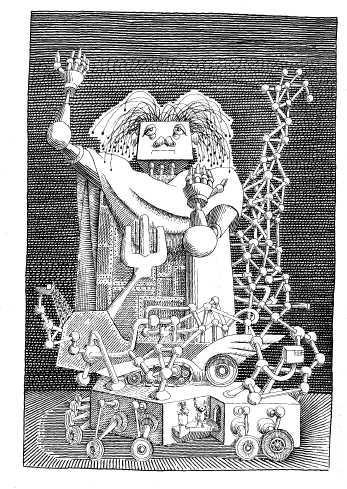
First of all, to avoid any possible misunderstanding, we should state that this was, strictly speaking, a sally to nowhere. In fact, Trurl never left his house throughout it— except for a few trips to the hospital and an unimportant excursion to some asteroid. Yet in a deeper and/or higher sense this was one of the farthest sallies ever undertaken by the famed constructor, for it very nearly took him beyond the realm of possibility.
Trurl had once had the misfortune to build an enormous calculating machine that was capable of only one operation, namely the addition of two and two, and that it did incorrectly. As is related earlier in this volume, the machine also proved to be extremely stubborn, and the quarrel that ensued between it and its creator almost cost the latter his life. From that time on Klapaucius teased Trurl unmercifully, making comments at every opportunity, until Trurl decided to silence him once and for all by building a machine that could write poetry. First Trurl collected eight hundred and twenty tons of books on cybernetics and twelve thousand tons of the finest poetry, then sat down to read it all. Whenever he felt he just couldn’t take another chart or equation, he would switch over to verse, and vice versa. After a while it became clear to him that the construction of the machine itself was child’s play in comparison with the writing of the program. The program found in the head of an average poet, after all, was written by the poet’s civilization, and that civilization was in turn programmed by the civilization that preceded it, and so on to the very Dawn of Time, when those bits of information that concerned the poet-to-be were still swirling about in the primordial chaos of the cosmic deep. Hence in order to program a poetry machine, one would first have to repeat the entire Universe from the beginning—or at least a good piece of it.
Anyone else in Trurl’s place would have given up then and there, but our intrepid constructor was nothing daunted. He built a machine and fashioned a digital model of the Void, an Electrostatic Spirit to move upon the face of the electrolytic waters, and he introduced the parameter of light, a protogalactic cloud or two, and by degrees worked his way up to the first ice age—Trurl could move at this rate because his machine was able, in one five-billionth of a second, to simulate one hundred septillion events at forty octillion different locations simultaneously. And if anyone questions these figures, let him work it out for himself.
Next Trurl began to model Civilization, the striking of fires with flints and the tanning of hides, and he provided for dinosaurs and floods, bipedality and taillessness, then made the paleopaleface (Albuminidis sapienria), which begat the paleface, which begat the gadget, and so it went, from eon to millennium, in the endless hum of electrical currents and eddies. Often the machine turned out to be too small for the computer simulation of a new epoch, and Trurl would have to tack on an auxiliary unit—until he ended up, at last, with a veritable metropolis of tubes and terminals, circuits and shunts, all so tangled and involved that the devil himself couldn’t have made head or tail of it. But Trurl managed somehow, he only had to go back twice —once, almost to the beginning, when he discovered that Abel had murdered Cain and not Cain Abel (the result, apparently, of a defective fuse), and once, only three hundred million years back to the middle of the Mesozoic, when after going from fish to amphibian to reptile to mammal, something odd took place among the primates and instead of great apes he came out with gray drapes. A fly, it seems, had gotten into the machine and shorted out the polyphase step-down directional widget. Otherwise everything went like a dream. Antiquity and the Middle Ages were recreated, then the period of revolutions and reforms —which gave the machine a few nasty jolts—and then civilization progressed in such leaps and bounds that Trurl had to hose down the coils and cores repeatedly to keep them from overheating.
Towards the end of the twentieth century the machine began to tremble, first sideways, then lengthwise-—for no apparent reason. This alarmed Trurl; he brought out cement and grappling irons just in case. But fortunately these weren’t needed; instead of jumping its moorings, the machine settled down and soon had left the twentieth century far behind. Civilizations came and went thereafter in fifty-thousand-year intervals: these were the fully intelligent beings from whom Trurl himself stemmed. Spool upon spool of computerized history was filled and ejected into storage bins; soon there were so many spools, that even if you stood at the top of the machine with high-power binoculars, you wouldn’t see the end of them. And all to construct some versifier! But then, such is the way of scientific fanaticism. At last the programs were ready; all that remained was to pick out the most applicable—else the electropoet’s education would take several million years at the very least.
During the next two weeks Trurl fed general instructions into his future electropoet, then set up all the necessary logic circuits, emotive elements, semantic centers. He was about to invite Klapaucius to attend a trial run, but thought better of it and started the machine himself. It immediately proceeded to deliver a lecture on the grinding of crystallo-graphical surfaces as an introduction to the study of sub-molecular magnetic anomalies. Trurl bypassed half the logic circuits and made the emotive more electromotive; the machine sobbed, went into hysterics, then finally said, blubbering terribly, what a cruel, cruel world this was. Trurl intensified the semantic fields and attached a strength of character component; the machine informed him that from now on he would carry out its every wish and to begin with add six floors to the nine it already had, so it could better meditate upon the meaning of existence. Trurl installed a philosophical throttle instead; the machine fell silent and sulked. Only after endless pleading and cajoling was he able to get it to recite something: “I had a little froggy.” That appeared to exhaust its repertoire. Trurl adjusted, modulated, expostulated, disconnected, ran checks, reconnected, reset, did everything he could think of, and the machine presented him with a poem that made him thank heaven Klapaucius wasn’t there to laugh—imagine, simulating the whole Universe from scratch, not to mention Civilization in every particular, and to end up with such dreadful doggerel! Trurl put in six cliche filters, but they snapped like matches; he had to make them out of pure corundum steel. This seemed to work, so he jacked the semanticity up all the way, plugged in an alternating rhyme generator—which nearly ruined everything, since the machine resolved to become a missionary among destitute tribes on far-flung planets. But at the very last minute, just as he was ready to give up and take a hammer to it, Trurl was struck by an inspiration; tossing out all the logic circuits, he replaced them with self-regulating egocentripetal narcissistors. The machine simpered a little, whimpered a little, laughed bitterly, complained of an awful pain on its third floor, said that in general it was fed up, through, life was beautiful but men were such beasts and how sorry they’d all be when it was dead and gone. Then it asked for pen and paper. Trurl sighed with relief, switched it off and went to bed. The next morning he went to see Klapaucius. Klapaucius, hearing that he was invited to attend the debut of Trurl’s electronic bard, dropped everything and followed—so eager was he to be an eyewitness to his friend’s humiliation.
Trurl let the machine warm up first, kept the power low, ran up the metal stairs several times to take readings (the machine was like the engine of a giant steamer, galleried, with rows of rivets, dials and valves on every tier)—till finally, satisfied all the decimal places were where they ought to be, he said yes, it was ready now, and why not start with something simple. Later, of course, when the machine had gotten the feel of it, Klapaucius could ask it to produce poetry on absolutely whatever topic he liked.
Now the potentiometers indicated the machine’s lyrical capacitance was charged to maximum, and Trurl, so nervous his hands were shaking, threw the master switch. A voice, slightly husky but remarkably vibrant and bewitching, said:
“Phlogisticosh. Rhomothriglyph. Floof.”
“Is that it?” inquired Klapaucius after a pause, extremely polite. Trurl only bit his lip, gave the machine a few kicks of current, and tried again. This time the voice came through much more clearly; it was a thrilling baritone, solemn yet intriguingly sensual: