Read ebook «The Cyberiad» online
Font size:
In those days Trurl was exceedingly vain, receiving all marks of veneration and honor paid to him as his due and a perfectly normal thing. He was heading north in his ship, as he was the least familiar with that region, and had flown through the void for quite some time, passing spheres full of the clamor of war as well as spheres that had finally obtained the perfect peace of desolation, when suddenly a little planet came into view, really more of a stray fragment of matter than a planet.
On the surface of this chunk of rock someone was run-ning back and forth, jumping and waving his arms in the strangest way. Astonished by a scene of such total loneliness and concerned by those wild gestures of despair, and perhaps of anger as well, Trurl quickly landed.
He was approached by a personage of tremendous hau-teur, iridium and vanadium all over and with a great deal of clanging and clanking, who introduced himself as Excelsius the Tartarian, ruler of Pancreon and Cyspenderora; the inhabitants of both these kingdoms had, in a fit of regicidal madness, driven His Highness from the throne and exiled him to this barren asteroid, eternally adrift among the dark swells and currents of gravitation.
Learning in turn the identity of his visitor, the deposed monarch began to insist that Trurl—who after all was something of a professional when it came to good deeds—immediately restore him to his former position. The thought of such a turn of events brought the flame of vengeance to the monarch’s eyes, and his iron fingers clutched the air, as if already closing around the throats of his beloved subjects.
Now Trurl had no intention of complying with this request of Excelsius, as doing so would bring about untold evil and suffering, yet at the same time he wished somehow to comfort and console the humiliated king. Thinking a moment or two, he came to the conclusion that, even in this case, not all was lost, for it would be possible to satisfy the king completely—without putting his former subjects in jeopardy. And so, rolling up his sleeves and summoning up all his mastery, Trurl built the king an entirely new kingdom. There were plenty of towns, rivers, mountains, forests and brooks, a sky with clouds, armies full of derring-do, citadels, castles and ladies’ chambers; and there were marketplaces, gaudy and gleaming in the sun, days of back-breaking labor, nights full of dancing and song until dawn, and the gay clatter of swordplay. Trurl also carefully set into this kingdom a fabulous capital, all in marble and alabaster, and assembled a council of hoary sages, and winter palaces and summer villas, plots, conspirators, false witnesses, nurses, informers, teams of magnificent steeds, and plumes waving crimson in the wind; and then he crisscrossed that atmosphere with silver fanfares and twenty-one gun salutes, also threw in the necessary handful of traitors, another of heroes, added a pinch of prophets and seers, and one mes-siah and one great poet each, after which he bent over and set the works in motion, deftly making last-minute adjustments with his microscopic tools as it ran, and he gave the women of that kingdom beauty, the men—sullen silence and surliness when drunk, the officials—arrogance and servility, the astronomers—an enthusiasm for stars, and the children—a great capacity for noise. And all of this, connected, mounted and ground to precision, fit into a box, and not a very large box, but just the size that could be carried about with ease. This Trurl presented to Excelsius, to rule and have dominion over forever; but first he showed him where the input and output of his brand-new kingdom were, and how to program wars, quell rebellions, exact tribute, collect taxes, and also instructed him in the critical points and transition states of that microminiaturized society—in other words the maxima and minima of palace coups and revolutions—and explained everything so well, that the king, an old hand in the running of tyrannies, instantly grasped the directions and, without hesitation, while the constructor watched, issued a few trial proclamations, correctly manipulating the control knobs, which were carved with imperial eagles and regal lions. These proclamations declared a state of emergency, martial law, a curfew and a special levy. After a year had passed in the kingdom, which amounted to hardly a minute for Trurl and the king, by an act of the greatest magnanimity—that is, by a flick of the finger at the controls—the king abolished one death penalty, lightened the levy and deigned to annul the state of emergency, whereupon a tumultuous cry of gratitude, like the squeaking of tiny mice lifted by their tails, rose up from the box, and through its curved glass cover one could see, on the dusty highways and along the banks of lazy rivers that reflected the fluffy clouds, the people rejoicing and praising the great and unsurpassed benevolence of their sovereign lord.
And so, though at first he had felt insulted by Trurl’s gift, in that the kingdom was too small and very like a child’s toy, the monarch saw that the thick glass lid made everything inside seem large; perhaps too he dully understood that size was not what mattered here, for government is not measured in meters and kilograms, and emotions are somehow the same, whether experienced by giants or dwarfs— and so he thanked the constructor, if somewhat stiffly. Who knows, he might even have liked to order him thrown in chains and tortured to death, just to be safe—that would have been a sure way of nipping in the bud any gossip about how some common vagabond tinkerer presented a mighty monarch with a kingdom.
Excelsius was sensible enough, however, to see that this was out of the question, owing to a very fundamental disproportion, for fleas could sooner take their host into captivity than the king’s army seize Trurl. So with another cold nod, he stuck his orb and scepter under his arm, lifted the box kingdom with a grunt, and took it to his humble hut of exile. And as blazing day alternated with murky night outside, according to the rhythm of the asteroid’s rotation, the king, who was acknowledged by his subjects as the greatest in the world, diligently reigned, bidding this, forbidding that, beheading, rewarding—in all these ways incessantly spurring his little ones on to perfect fealty and worship of the throne.
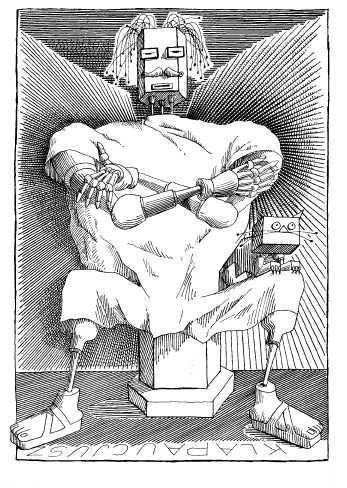
As for Trurl, he returned home and related to his friend Klapaucius, not without pride, how he had employed his constructor’s genius to indulge the autocratic aspirations of Excelsius and, at the same time, safeguard the democratic aspirations of his former subjects. But Klapaucius, surprisingly enough, had no words of praise for Trurl; in fact, there seemed to be rebuke in his expression.
“Have I understood you correctly?” he said at last. “You gave that brutal despot, that born slave master, that slavering sadist of a painmonger, you gave him a whole civilization to rule and have dominion over forever? And you tell me, moreover, of the cries of joy brought on by the repeal of a fraction of his cruel decrees! Trurl, how could you have done such a thing?!”
“You must be joking!” Trurl exclaimed. “Really, the whole kingdom fits into a box three feet by two by two and a half… it’s only a model…”
“A model of what?”
“What do you mean, of what? Of a civilization, obviously, except that it’s a hundred million times smaller.”
“And how do you know there aren’t civilizations a hundred million times larger than our own? And if there were, would ours then be a model? And what importance do dimensions have anyway? In that box kingdom, doesn’t a journey from the capital to one of the corners take months —for those inhabitants? And don’t they suffer, don’t they know the burden of labor, don’t they die?”
“Now just a minute, you know yourself that all these processes take place only because I programmed them, and so they aren’t genuine…”
“Aren’t genuine? You mean to say the box is empty, and the parades, tortures and beheadings are merely an illusion?”
“Not an illusion, no, since they have reality, though purely as certain microscopic phenomena, which I produced by manipulating atoms,” said Trurl. “The point is, these births, loves, acts of heroism and denunciations are nothing but the minuscule capering of electrons in space, precisely arranged by the skill of my nonlinear craft, which—”
“Enough of your boasting, not another word!” Klapaucius snapped. “Are these processes self-organizing or not?”
“Of course they are!”
“And they occur among infinitesimal clouds of electrical charge?”
“You know they do.”
“And the phenomenological events of dawns, sunsets and bloody battles are generated by the concatenation of real variables?”
“Certainly.”
“And are not we as well, if you examine us physically, mechanistically, statistically and meticulously, nothing but the minuscule capering of electron clouds? Positive and negative charges arranged in space? And is our existence not the result of subatomic collisions and the interplay of particles, though we ourselves perceive those molecular cartwheels as fear, longing, or meditation? And when you daydream, what transpires within your brain but the binary algebra of connecting and disconnecting circuits, the continual meandering of electrons?”
“What, Klapaucius, would you equate our existence with that of an imitation kingdom locked up in some glass box?!” cried Trurl. “No, really, that’s going too far! My purpose was simply to fashion a simulator of statehood, a model cybernetically perfect, nothing more!”
“Trurl! Our perfection is our curse, for it draws down upon our every endeavor no end of unforeseeable consequences!” Klapaucius said in a stentorian voice. “If an imperfect imitator, wishing to inflict pain, were to build himself a crude idol of wood or wax, and further give it some makeshift semblance of a sentient being, his torture of the thing would be a paltry mockery indeed! But consider a succession of improvements on this practice! Consider the next sculptor, who builds a doll with a recording in its belly, that it may groan beneath his blows; consider a doll which, when beaten, begs for mercy, no longer a crude idol, but a homeostat; consider a doll that sheds tears, a doll that bleeds, a doll that fears death, though it also longs for the peace that only death can bring! Don’t you see, when the imitator is perfect, so must be the imitation, and the semblance becomes the truth, the pretense a reality! Trurl, you took an untold number of creatures capable of suffering and abandoned them forever to the rule of a wicked tyrant… Trurl, you have committed a terrible crime!”
“Sheer sophistry!” shouted Trurl, all the louder because he felt the force of his friend’s argument. “Electrons meander not only in our brains, but in phonograph records as well, which proves nothing, and certainly gives no grounds for such hypostatical analogies! The subjects of that monster Excelsius do in fact die when decapitated, sob, fight, and fall in love, since that is how I set up the parameters, but it’s impossible to say, Klapaucius, that they feel anything in the process—the electrons jumping around in their heads will tell you nothing of that!”
“And if I were to look inside your head, I would also see nothing but electrons,” replied Klapaucius. “Come now, don’t pretend not to understand what I’m saying, I know you’re not that stupid! A phonograph record won’t run errands for you, won’t beg for mercy or fall on its knees! You say there’s no way of knowing whether Excelsius’ subjects groan, when beaten, purely because of the electrons hopping about inside—like wheels grinding out the mimicry of a voice—or whether they really groan, that is, because they honestly experience the pain? A pretty distinction, this! No, Trurl, a sufferer is not one who hands you his suffering, that you may touch it, weigh it, bite it like a coin; a sufferer is one who behaves like a sufferer! Prove to me here and now, once and for all, that they do not feel, that they do not think, that they do not in any way exist as beings conscious of their enclosure between the two abysses of oblivion—the abyss before birth and the abyss that follows death—prove this to me, Trurl, and I’ll leave you be! Prove that you only imitated suffering, and did not create it!”
“You know perfectly well that’s impossible,” answered Trurl quietly. “Even before I took my instruments in hand, when the box was still empty, I had to anticipate the possibility of precisely such a proof—in order to rule it out. For otherwise the monarch of that kingdom sooner or later would have gotten the impression that his subjects were not real subjects at all, but puppets, marionettes. Try to understand, there was no other way to do it! Anything that would have destroyed in the littlest way the illusion of complete reality, would have also destroyed the importance, the dignity of governing, and turned it into nothing but a mechanical game.…”
“I understand, I understand all too well!” cried Klapau-cius. “Your intentions were the noblest—you only sought to construct a kingdom as lifelike as possible, so similar to a real kingdom, that no one, absolutely no one, could ever tell the difference, and in this, I am afraid, you were successful! Only hours have passed since your return, but for them, the ones imprisoned in that box, whole centuries have gone by —how many beings, how many lives wasted, and all to gratify and feed the vanity of King Excelsius!”