Read ebook «The Cyberiad» online
Font size:
“Nothing is nothing!”
“Come, come. It was supposed to do Nothing, but it hasn’t done anything, and therefore I’ve won. For Nothing, my dear and clever colleague, is not your run-of-the-mill nothing, the result of idleness and inactivity, but dynamic, aggressive Nothingness, that is to say, perfect, unique, ubiquitous, in other words Nonexistence, ultimate and supreme, in its very own nonperson!”
“You’re confusing the machine!” cried Trurl. But suddenly its metallic voice rang out:
“Really, how can you two bicker at a time like this? Oh yes, I know what Nothing is, and Nothingness, Nonexistence, Nonentity, Negation, Nullity and Nihility, since all these come under the heading of n, n as in Nil. Look then upon your world for the last time, gentlemen! Soon it shall no longer be…”
The constructors froze, forgetting their quarrel, for the machine was in actual fact doing Nothing, and it did it in this fashion: one by one, various things were removed from the world, and the things, thus removed, ceased to exist, as if they had never been. The machine had already disposed of nolars, nightzebs, nocs, necs, nallyrakers, neotremes and nonmalrigers. At moments, though, it seemed that instead of reducing, diminishing and subtracting, the machine was increasing, enhancing and adding, since it liquidated, in turn: nonconformists, nonentities, nonsense, nonsupport, nearsightedness, narrowmindedness, naughtiness, neglect, nausea, necrophilia and nepotism. But after a while the world very definitely began to thin out around Trurl and Klapaucius.
“Omigosh!” said Trurl. “If only nothing bad comes out of all this…”
“Don’t worry,” said Klapaucius. “You can see it’s not producing Universal Nothingness, but only causing the absence of whatever starts with n. Which is really nothing in the way of nothing, and nothing is what your machine, dear Trurl, is worth!”
“Do not be deceived,” replied the machine. “I’ve begun, it’s true, with everything in n, but only out of familiarity. To create however is one thing, to destroy, another thing entirely. I can blot out the world for the simple reason that I’m able to do anything and everything—and everything means everything—in n, and consequently Nothingness is child’s play for me. In less than a minute now you will cease to have existence, along with everything else, so tell me now, Klapaucius, and quickly, that I am really and truly everything I was programmed to be, before it is too late.”
“But—” Klapaucius was about to protest, but noticed, just then, that a number of things were indeed disappearing, and not merely those that started with n. The constructors were no longer surrounded by the gruncheons, the targalisks, the shupops, the calinatifacts, the thists, worches and pritons.
“Stop! I take it all back! Desist! Whoa! Don’t do Nothing!!” screamed Klapaucius. But before the machine could come to a full stop, all the brashations, plusters, laries and zits had vanished away. Now the machine stood motionless. The world was a dreadful sight. The sky had particularly suffered: there were only a few, isolated points of light in the heavens—no trace of the glorious worches and zits that had, till now, graced the horizon!
“Great Gauss!” cried Klapaucius. “And where are the gruncheons? Where my dear, favorite pritons? Where now the gentle zits?!”
“They no longer are, nor ever will exist again,” the machine said calmly. “I executed, or rather only began to execute, your order…”
“I tell you to do Nothing, and you… you…”
“Klapaucius, don’t pretend to be a greater idiot than you are,” said the machine. “Had I made Nothing outright, in one fell swoop, everything would have ceased to exist, and that includes Trurl, the sky, the Universe, and you—and even myself. In which case who could say and to whom could it be said that the order was carried out and I am an efficient and capable machine? And if no one could say it to no one, in what way then could I, who also would not be, be vindicated?”
“Yes, fine, let’s drop the subject,” said Klapaucius. “I have nothing more to ask of you, only please, dear machine, please return the zits, for without them life loses all its charm…”
“But I can’t, they’re in z,” said the machine. “Of course, I can restore nonsense, narrowmindedness, nausea, necrophilia, neuralgia, nefariousness and noxiousness. As for the other letters, however, I can’t help you.”
“I want my zits!” bellowed Klapaucius.
“Sorry, no zits,” said the machine. “Take a good look at this world, how riddled it is with huge, gaping holes, how full of Nothingness, the Nothingness that fills the bottomless void between the stars, how everything about us has become lined with it, how it darkly lurks behind each shred of matter. This is your work, envious one! And I hardly think the future generations will bless you for it…”
“Perhaps… they won’t find out, perhaps they won’t notice,” groaned the pale Klapaucius, gazing up incredulously at the black emptiness of space and not daring to look his colleague, Trurl, in the eye. Leaving him beside the machine that could do everything in n, Klapaucius skulked home—and to this day the world has remained honeycombed with nothingness, exactly as it was when halted in the course of its liquidation. And as all subsequent attempts to build a machine on any other letter met with failure, it is to be feared that never again will we have such marvelous phenomena as the worches and the zits—no, never again.
TRURL’S MACHINE
TRURL’S MACHINE
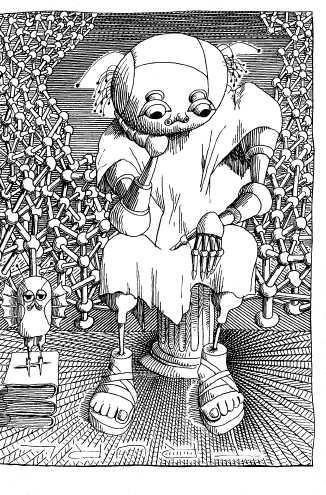
Once upon a time Trurl the constructor built an eight-story thinking machine. When it was finished, he gave it a coat of white paint, trimmed the edges in lavender, stepped back, squinted, then added a little curlicue on the front and, where one might imagine the forehead to be, a few pale orange polkadots. Extremely pleased with himself, he whistled an air and, as is always done on such occasions, asked it the ritual question of how much is two plus two.
The machine stirred. Its tubes began to glow, its coils warmed up, current coursed through all its circuits like a waterfall, transformers hummed and throbbed, there was a clanging, and a chugging, and such an ungodly racket that Trurl began to think of adding a special mentation muffler. Meanwhile the machine labored on, as if it had been given the most difficult problem in the Universe to solve; the ground shook, the sand slid underfoot from the vibration, valves popped like champagne corks, the relays nearly gave way under the strain. At last, when Trurl had grown extremely impatient, the machine ground to a halt and said in a voice like thunder: SEVEN!
“Nonsense, my dear,” said Trurl. “The answer’s four. Now be a good machine and adjust yourself! What’s two and two?”
“SEVEN!” snapped the machine. Trurl sighed and put his coveralls back on, rolled up his sleeves, opened the bottom trapdoor and crawled in. For the longest time he hammered away inside, tightened, soldered, ran clattering up and down the metal stairs, now on the sixth floor, now on the eighth, then pounded back down to the bottom and threw a switch, but something sizzled in the middle, and the spark plugs grew blue whiskers. After two hours of this he came out, covered with soot but satisfied, put all his tools away, took off his coveralls, wiped his face and hands. As he was leaving, he turned and asked, just so there would be no doubt about it:
“And now what’s two and two?”
“SEVEN!” replied the machine.
Trurl uttered a terrible oath, but there was no help for it—again he had to poke around inside the machine, disconnecting, correcting, checking, resetting, and when he learned for the third time that two and two was seven, he collapsed in despair at the foot of the machine, and sat there until Klapaucius found him. Klapaucius inquired what was wrong, for Trurl looked as if he had just returned from a funeral. Trurl explained the problem. Klapaucius crawled into the machine himself a couple of times, tried to fix this and that, then asked it for the sum of one plus two, which turned out to be six. One plus one, according to the machine, equaled zero. Klapaucius scratched his head, cleared his throat and said:
“My friend, you’ll just have to face it. That isn’t the machine you wished to make. However, there’s a good side to everything, including this.”